
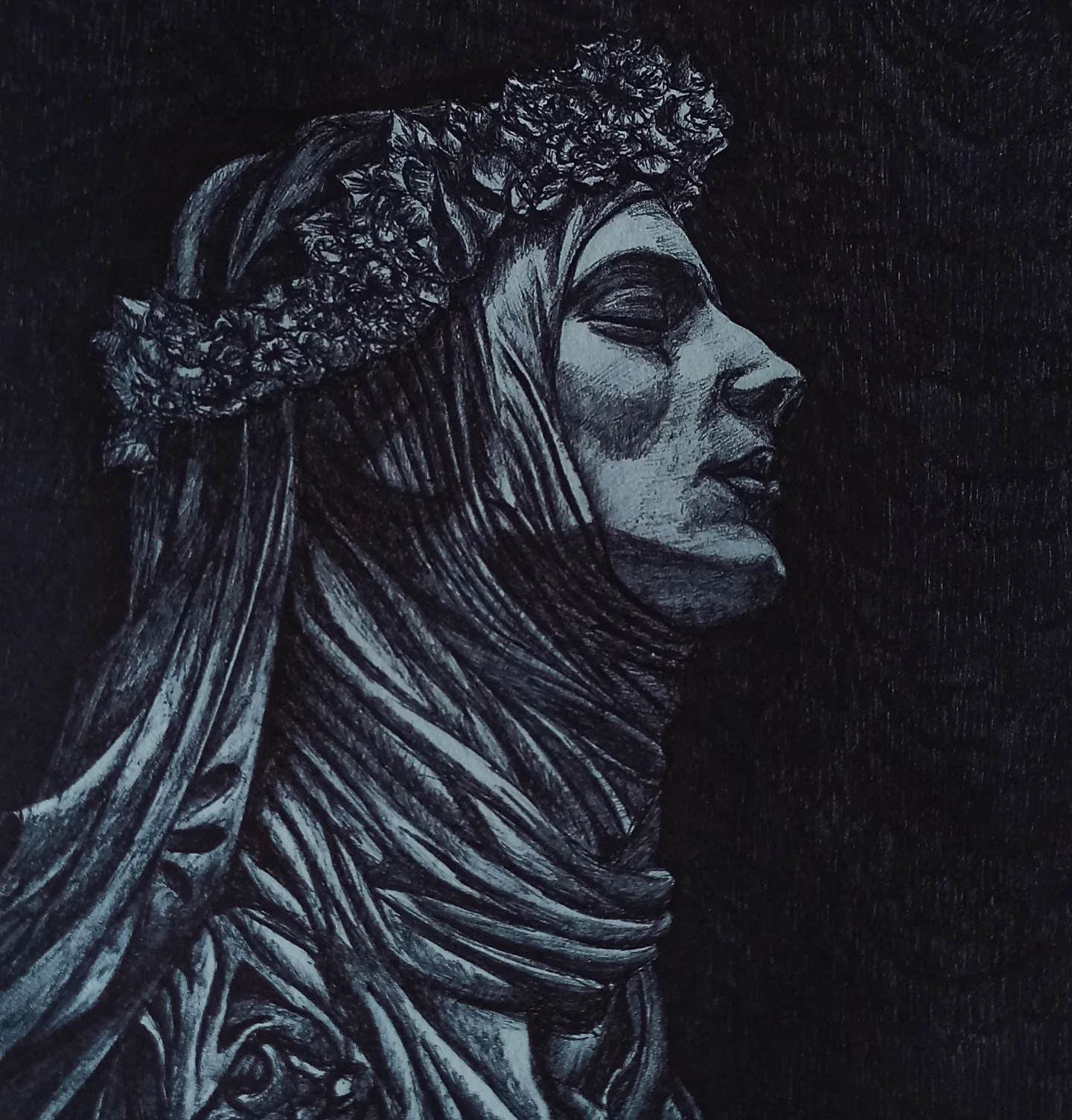
Julia Bilakiewicz is a Polish artist and visual creator based in Wrocław, known for her intricate traditional drawings, paintings, and mixed-media art. She creates and shares her diverse portfolio including hyper-detailed pen sketches, acrylic paintings, and custom artwork on her Julia Bilakiewicz Instagram Profile.
- Name: Julia Bilakiewicz
- Location: Poland
- Mediums: She works across multiple mediums, frequently using ink, charcoal, acrylic, and oil paints.
- Themes: Her artwork often spans dark art, classical sculpture redraws, portraiture, and macabre subjects.
Artistic Philosophy & The Viewer Experience
The contemporary practice of Julia Bilakiewicz centers on deliberate structural geometry to articulate complex interior psychological states. Bilakiewicz constructs compositions that engage the viewer as an analytical observer of human emotion investigating states of isolation, vulnerability, internal friction, and solemnity. By stripping away extraneous narrative contextual details, the work relies strictly on formal execution to project these abstract emotional planes directly onto the physical anatomy of her subjects.
Translation of Emotion Through Form
Bilakiewicz translates abstract emotional states into precise visual data through controlled structural methodologies:
- Tension via Line Density: Psychological weight is quantified by the friction of the medium. The compression of tight cross-hatching and directional fine-line strokes regulates the perceived degree of emotional containment, anxiety, or internal distress communicated to the viewer.
- Duality via Chromatic Temperature: Internal conflict is established without relying on overt facial distortion. By splitting the planar space with contrasting color temperatures, juxtaposing cool slate-greys against warm terracotta values, the artist establishes a clear axis of psychological tension directly across the subject’s visage.
- Vulnerability via Chiaroscuro Dynamics: Utilizing stark, directional light anchors to illuminate precise anatomical features while leaving the surrounding form consumed by deep shadows deprives the subjects of defensive context, presenting an unshielded, objective state of vulnerability.
See Julia’s work
Latest Pieces
- Veiled Virgin | Julia Bilakiewicz
 Title: Veiled VirginArtist: Julia BilakiewiczSubject: Portrait of a veiled female figure wearing floral crownVisual Style: Monochromatic graphic realismMedium: Pen on paperColor Palette: Black, grey, white Compositional Architecture & Spatial Mass The composition relies on an asymmetrical layout. The vertical axis divides the frame into two primary zones. The left half holds the mass of the… Read more: Veiled Virgin | Julia Bilakiewicz
 - Autumn Sunset | Julia Bilakiewicz
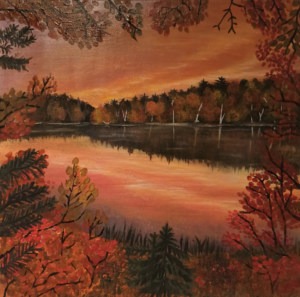 Title: Autumn sunsetArtist: Julia BilakiewiczSubject: Lake landscape framed by autumn foliageVisual Style: Representational landscapeMedium: Acrylic on canvas, 45×45 cmColor Palette: Terracotta, russet, deep olive green, charcoal, warm amber Compositional Architecture & Spatial Mass The structural foundation of “Autumn sunset” relies on a 45×45 centimeter square grid, compartmentalized into three highly distinct, non-overlapping spatial planes: an… Read more: Autumn Sunset | Julia Bilakiewicz
 - Presence | Julia Bilakiewicz
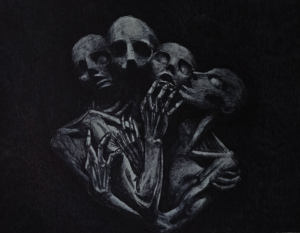 Title: “Obecność” (Presence)Artist: Julia BilakiewiczSubject: Skeletal humanoid formsVisual Style: Monochromatic figurative surrealismMedium: Pen drawingColor Palette: Black, grey, white The monochromatic drawing in Obecność anchors its thematic focus on an interconnected cluster of skeletal, emaciated humanoid forms emerging from darkness. High-contrast white and grey linework defines the anatomical contours, establishing a dense, central geometric mass against… Read more: Presence | Julia Bilakiewicz