
Title: Veiled Virgin
Artist: Julia Bilakiewicz
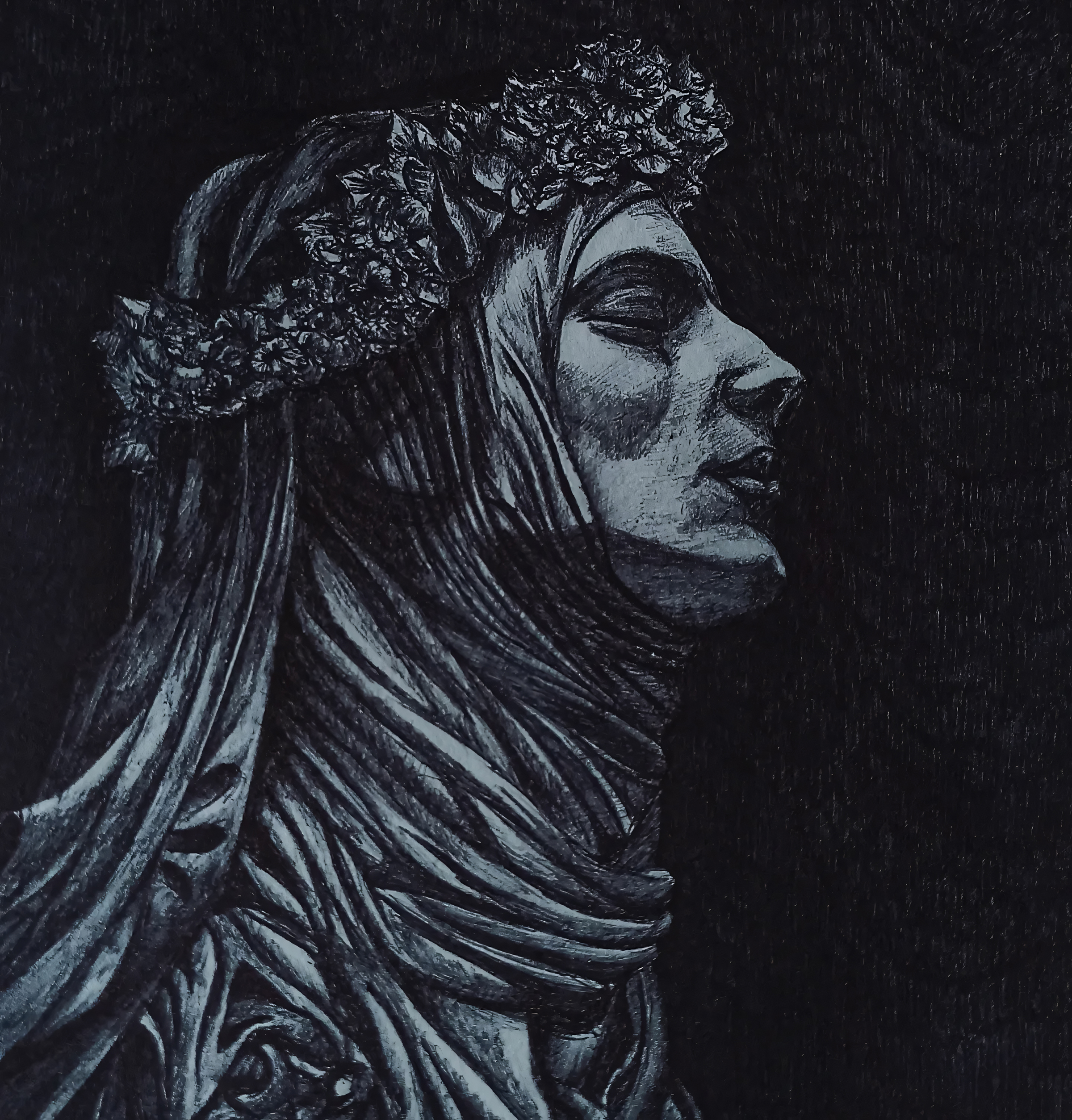
Subject: Portrait of a veiled female figure wearing floral crown
Visual Style: Monochromatic graphic realism
Medium: Pen on paper
Color Palette: Black, grey, white
Compositional Architecture & Spatial Mass
The composition relies on an asymmetrical layout. The vertical axis divides the frame into two primary zones. The left half holds the mass of the figure, while the right half functions as negative space. This distribution stabilizes the profile view. The figure faces right, creating a trajectory toward the right boundary. The main profile line bisects the upper right quadrant, establishing a clean boundary between form and void.
The canvas separates into three layers. The background is a black plane that compresses the central subject. The midground contains the rear drapery and the back of the crown, which unifies the form. The foreground holds the sharp edge of the profile, the face, and the front folds of the veil. This foreground plane carries the highest weight due to contrast.
Analyzing the composition by quadrants clarifies the distribution of mass. The top-left quadrant contains the rear part of the crown and the upper veil, presenting structural density. The top-right quadrant consists of negative space, containing only the profile outline of the nose and lips. This open space allows the profile to project cleanly without interference. The bottom-left quadrant holds the highest mass, where the drapery of the veil pools and anchors the system. The bottom-right quadrant contains the lower neck folds before transitioning into dark space. The figure occupies the leftmost two-thirds of the horizontal plane, while the negative space consumes the remaining rightmost third.
The mass forms a right triangle. The base anchors at the bottom left corner. The diagonal vector ascends along the neck and chin, terminating at the crown apex. The right perimeter remains empty, creating balance. This negative space counterbalances the heavy linework on the left. The top edge truncates the crown. The bottom edge crops the shoulders, forcing the gaze upward along the vertical axis. The composition compartmentalizes the spatial area to focus on the anatomical form.
Chromatic Topography & Value Distribution
This work uses an achromatic scale. The value hierarchy consists of three zones. Low-key values occupy approximately 60% of the canvas. These zones comprise the background and the deepest folds of the veil. Midtones cover 30% of the surface, establishing the plane transitions across the face, neck, and drapery. High-key highlights represent the remaining 10%. These highlights sit on the bridge of the nose, the brow ridge, the chin, and the top surfaces of the crown.
Value contrast acts as a mechanical funnel for the viewer’s eye. The gaze starts at the contrast zone of the facial profile, where white meets black. The boundary lines route the eye down the vertical curve of the nose to the lip and chin. From this point, the eye follows the midtones down the compressed folds of the neck drapery. Finally, the eye loops upward along the diagonal lines of the veil to rest on the complex values of the crown. The highlight on the nasal bone forms a vertical shape, while the shadow beneath the submental triangle forms a dark trapezoid.
The chromatic relationship depends on value saturation and opacity. Temperature is absent. The opacity of the greys isolates the form from its environment. The transitions between values occur through tight gradients, which translates volume onto a flat surface. The distribution of light stabilizes the anatomical proportions.
The interaction between the black background and the white highlights creates an illusion of depth. The shades operate as a physical void that forces the lighter values forward. This mechanic structures the illusion of a veil over solid flesh. The highlights on the nose and chin act as anchor points, preventing the portrait from merging into the background plane.
Somatic & Psychological Translation
The work presents structural tension through anatomical positioning. The upward angle of the chin creates a linear trajectory that suggests elevation and grace. This placement aligns with the closed eyelids, translating an internal state of rest.
Geometric equilibrium balances this. The stillness of the background isolates the subject, removing distractions.
The representation of the veil functions as a structural barrier. It separates the figure from the environment, reinforcing the subject. The wrapped throat compresses the neck anatomy, creating an internal sense of protection that complements the expression of the face. This congruence enhances the psychological impact of the image.